Before a Move, Give Each Useful Object a Destination
A pre-move sorting routine helps you separate agreed handoffs, donations, and household recycling before packing, so fewer unwanted items travel to your new home.
The common pre-move mistake is leaving unwanted objects until the final packing days. Then donation hours, pickup arrangements, and local disposal rules compete with moving tasks, and items may end up in boxes simply because there is no time to deal with them. Start routing outgoing belongings early, while you can still arrange a handoff or check what a service accepts.
Keep the focus on moving logistics rather than trying to make every decision at once. Separate items staying in the household from items leaving it, then choose a workable route for each outgoing group. Think of the process like sorting mail: a clear route matters more than a perfect label.
Set up separate routes for items leaving the home
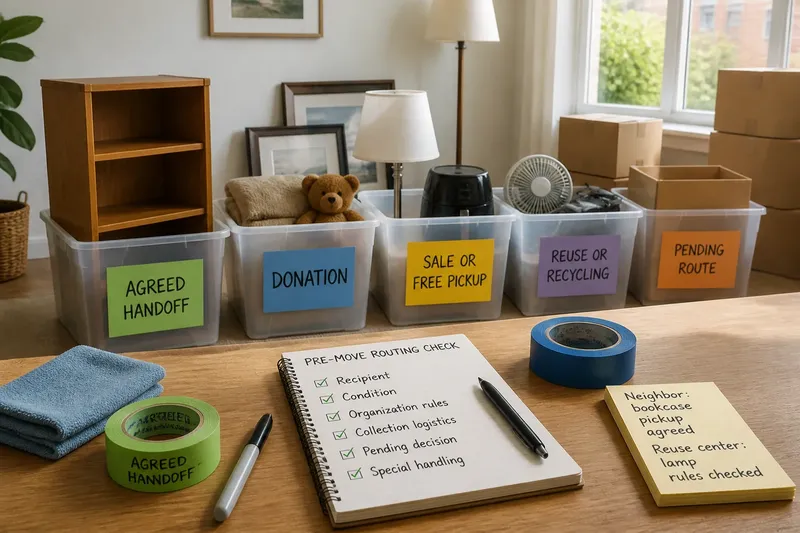
Choose a sorting spot that will not block a doorway or a mover’s path. Use painter’s tape, a marker, paper, and bins or boxes to distinguish these routes:
- Agreed handoff: A named person has said they will take the item.
- Donation: A specific organization accepts the item in its current condition.
- Sale or free pickup: You have chosen a platform or local group and can manage the messages and collection.
- Reuse or recycling: A local service accepts that type of material or object.
- Pending route: One specific question remains, with a decision date written beside the item.
Check the receiving organization’s current rules before loading a car or arranging a drop-off. Acceptance can depend on item type and condition. Keep different destinations separate so a confirmed donation does not get mixed with an unclaimed pickup.
Clear the routes that take coordination first
Start with bulky furniture, working appliances, and items that need a recipient or collection appointment. Contact one recipient at a time. Describe the object, its condition, and any missing parts, then agree on a pickup window before moving it into the handoff area.
For donations, check opening hours, collection arrangements, and accepted condition. For a sale or free pickup, set a response deadline that fits your packing schedule. If no one commits by that date, move to another suitable route instead of leaving the object in limbo.
Say you are moving from an apartment with a bookcase and a floor lamp you will not take. You message a neighbor about the bookcase and a relative about the lamp, including their condition and asking each to confirm a pickup window before your last packing day. The neighbor agrees, but the relative declines; you keep the bookcase in the agreed handoff area and check a local reuse organization’s current rules for the lamp. The result is one arranged transfer and one separate, actionable route.
Use this pre-move routing check for every outgoing item
- Recipient: Is a specific person named, and have they agreed? If yes, record the pickup plan; if no, do not mark the item as promised and choose another route or set a short reply deadline.
- Condition: Are the item’s working state and visible damage clear? If it is usable and the receiving route accepts it, proceed; if not, disclose the issue or choose a route that handles its condition.
- Organization rules: Have you confirmed that the charity or reuse service accepts this item? If yes, note its drop-off or collection arrangement; if no, check another organization or route.
- Collection logistics: Can the item be carried or collected before the move? If yes, schedule the handoff; if no, ask about another collection option or select a different destination.
- Pending decision: Is there one written question and a decision date? If yes, keep the item separate until that date; if no, set a specific deadline or make the route decision now.
- Special handling: Does the item contain batteries, electronics, paint, or another material with special disposal rules? If yes, consult the product label and local service guidance; if unclear, ask the service or a qualified professional rather than using ordinary household recycling.
Keep daily-use objects until their last practical day
Not every outgoing item should leave early. Keep essentials you still need for cooking, cleaning, sleeping, or closing the home, then route them as soon as you can manage without them. Put aside a small set of cleaning supplies and the tools needed for final packing; mark them clearly so they do not disappear into an outgoing load.
On the day before the move, walk through each room and check shelves, drawers, closets, and the backs of doors. Confirm that agreed pickups are still arranged, donations are ready for their confirmed destination, and pending items have reached their decision date. If a route fell through, choose a realistic alternative rather than placing the object in a moving box by default.
What should happen to an item that has no confirmed recipient?
Should I leave an item outside for pickup?
Only do so if the recipient has agreed and the location is permitted and safe. Otherwise, keep the item inside and use a confirmed handoff, accepted donation, or suitable local service.
How should I handle a donation near moving day?
Check the organization’s current acceptance rules and hours before making the trip. If it cannot take the item in time, contact another suitable organization or ask the local reuse or waste service about options.
What if a buyer or recipient stops replying?
Use the deadline you gave and send one clear follow-up if time allows. If there is still no agreement, cancel that route and choose an available alternative.
Where should I take electronics or household chemicals?
Follow product labels and local collection guidance because these materials may have special handling rules. If the correct route remains unclear, contact the relevant service or a qualified professional.
Keep records simple enough to use on moving day
Write each confirmed destination and pickup arrangement on a single paper or phone note. Use names and locations you can recognize quickly, such as “neighbor: bookcase, pickup agreed” or “reuse center: lamp, rules checked.” Keep the note with your moving documents, not inside a box that is hard to find.
Once the outgoing items are cleared, label the remaining boxes by room and contents so movers can place them without guesswork. Keep special handling instructions visible on the relevant container, and set aside essentials you need immediately after arrival.
A useful pre-move sorting routine ends with a route you can actually carry out, not merely a pile marked for later. Keep the note until each handoff or drop-off is complete; if one arrangement changes, update that line before the moving day rush turns an old plan into an unwanted box.