A Jar Is Not Automatically a Better Container
Decide which jars to reuse by checking cleanliness, fit, and a specific job, so useful containers stay accessible and unwanted glass does not crowd your cupboard.
The common mistake with an empty jar is putting it aside before deciding what it can do. A jar kept on vague promise can sit dirty, lose its lid, and take the space you need for something useful. To reuse jars well, match each one to a real task before it enters storage.
Choose a job that suits the jar
Start with the thing you need to contain, not the jar’s potential. A wide mouth may make buttons easy to reach; a narrow one may work better for pouring but frustrate retrieval. Check the jar’s height and shape against the drawer, shelf, or counter where the contents will live.
Consider whether you will use the contents often. A jar for rubber bands needs to open easily and sit where you can reach it. For occasional small parts, a labeled jar may work, but an open box can be simpler if you do not need a lid.
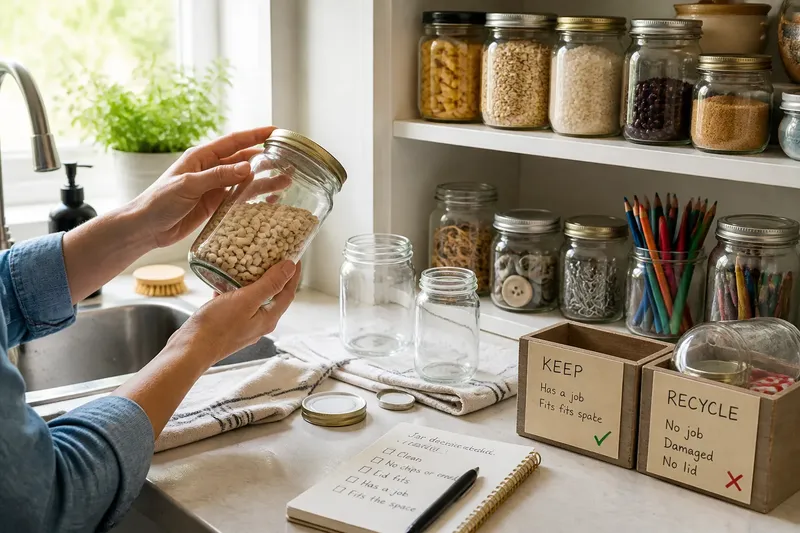
Imagine you have emptied a pasta sauce jar and keep dry beans in a cupboard. You rinse it, find no chips, confirm its mouth is wide enough for your scoop, and set it beside the other pantry containers. The result is a clear choice: keep it for beans if it fits without displacing a container you already use; otherwise, recycle it according to local rules.
Clean and inspect the jar before assigning it
Rinse a jar soon after emptying it, then check the inside, rim, and threads. Dried food in a narrow neck can be difficult to remove, and a lingering odor may affect what you store next. Soak a paper label if that makes it easier to remove, but do not turn a small reuse into a long cleanup project.
Inspect the glass for chips and cracks, especially around the rim. Check the lid for rust, a bent edge, damaged lining, or trapped residue. Keep the lid with the jar and test the pair; a similar-looking lid is not necessarily a fit.
For food storage, use a clean, sound jar suited to the intended food and handling. Do not rely on a worn or questionable lid. For preserving food or anything that requires a particular seal, follow current food-safety guidance and the container maker’s instructions.
Use the storage spot to limit your collection
Choose a defined place for jars rather than letting them spread across cupboards. Keep them upright, visible, and easy to lift out. Glass jars can chip when crowded, so avoid balancing them in a tall pile or forcing one inside another.
When the chosen shelf or bin is full, compare jars by their actual jobs. Keep the one that best fits a named task and storage spot. Let go of duplicates, awkward shapes, damaged jars, and containers with missing lids when the intended use requires one.
A jar is like a spare button: useful when you know which garment needs it, but clutter when saved without a plausible match. The space you set aside is a boundary, not an invitation to find more places for jars.
Match the reuse to the material and task
Different uses call for different features. A jar suitable for desk supplies may not suit food, and an attractive jar may still be awkward for everyday access.
- Small household items: Check that the jar is clean and sound and that its opening lets you retrieve the contents. If it does, use it for items such as buttons; if not, choose a wider container or a small box.
- Pantry goods: Check that the jar is clean, dry, easy to open, and suited to the ingredient. If it meets those conditions and fits the shelf, use it with a clear label when identification matters; if not, keep the ingredient in its existing suitable container.
- Craft supplies: Check whether the contents are easy to see and remove. If they are, a jar can gather loose supplies; if they are not, choose a container with a wider opening or separate compartments.
- Display or a simple vase: Check for a sound rim and a stable place to set it. If it stands securely and can be handled safely, use it; if it wobbles or has a damaged edge, choose another vessel.
Do not use a reused jar in an appliance or for a task with specific temperature or material requirements unless the manufacturer says it is suitable. Choose a different container when the job calls for something lighter, flexible, or designed for a particular kind of use.
Which jar should you keep?
Can I keep a jar without its original lid?
Yes, if the planned job does not need a cover, such as holding pens. If the contents need to be covered, keep the jar only after you find and test its matching lid.
Should I keep jars in several sizes?
Keep different sizes when each suits a distinct task or storage spot. If two jars compete for the same job, choose the one that is easier to clean, open, and store, and release the other.
What should I do if a jar still smells after washing?
Do not use it for food or odor-sensitive contents while the smell remains. If it is otherwise sound, consider a non-sensitive use; if no suitable task comes to mind, recycle it where accepted.
Can I use a reused jar for leftovers?
That depends on the jar’s condition, lid, food, and handling needs. Use a suitable food container and follow food-safety guidance rather than assuming every reused jar works for every leftover.
Make the next jar decision at the sink
When you empty a jar, rinse it, inspect the glass and lid, and name the job it would do. Then check whether it fits the place where that job happens. If the jar is damaged, hard to clean, missing a needed lid, or has no clear use, do not move it into storage just because it is empty.
For each jar you keep, pair its lid with it and place the set near the task it serves. If the task disappears or the jar stays in the way, reconsider the choice. Reusing jars works best when the container solves a specific problem without creating another one.